
Eissa Fiber Glass LLC provides reliable GRP, FRP and GRE solutions for construction, infrastructure, industrial, marine, power and water-treatment applications across the UAE.
Get a Quote
Eissa Fiber Glass LLC provides reliable GRP, FRP and GRE solutions for construction, infrastructure, industrial, marine, power and water-treatment applications across the UAE.
Get a Quote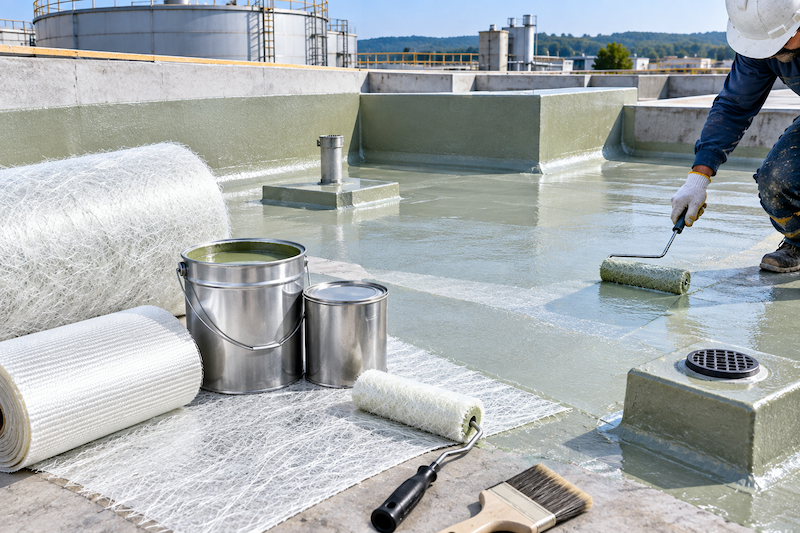
The GRP (Glass Reinforced Plastic) Waterproofing System is a high-performance, seamless solution engineered to provide long-lasting water resistance and comprehensive structural preservation. Applied by consolidating multiple layers of high-tensile fiberglass reinforcement with premium thermoset resin matrices, it forms an impermeable, joint-free, and monolithic barrier directly over the host substrate.
This system effectively eliminates leakage, moisture seepage, and water capillary migration, while shielding concrete, masonry, and steel surfaces from aggressive chemical attack, corrosion, and severe climate exposure. Its superior adhesion profile makes it equally effective for new structural construction and remediation of aging, deteriorating facilities.
We engineer our barrier systems using tailored resin systems to match specific containment and environmental demands:
Formulated using high-grade Isophthalic Polyester resins for reliable containment of water and general environmental exposure.
Engineered using premium Vinyl Ester or Epoxy resin systems designed for harsh chemical and thermal environments.
Our lining systems are installed using systematic multi-tier composite layering to ensure complete consolidation and bond strength:
| Application Stage | Execution & Engineering Purpose |
|---|---|
| 1. Surface Preparation | Concrete surfaces are mechanically grit-blasted or diamond ground to remove laitance and achieve an open CSP-3 profile; steel is grit-blasted to SA 2.5. |
| 2. Primer Coat | Application of high-penetration resin primer to fill concrete pores and create an anchor profile for composite lamination. |
| 3. Coving & Filleting | GRP putty filleting applied at all 90-degree internal corners, plinths, and pipe penetration sleeves to prevent stress concentration. |
| 4. Fiberglass Lamination | Application of multiple layers of Chopped Strand Mat (CSM 450/600 g/m²) impregnated with resin, de-aerated using ribbed rollers to eliminate micro-voids. |
| 5. Protective Topcoat | Application of a pigmented, UV-stabilized paraffinated flow-coat (or food-grade gelcoat) providing a smooth, pinhole-free finish. |
Bituminous membranes rely on overlapping seams that are vulnerable to joint separation, water tracking, and mechanical puncturing. In contrast, GRP is cold-applied in-situ to form a monolithic, joint-free rigid shell that bonds chemically to the concrete, preventing subsurface water tracking even if surface damage occurs.
Yes. When lining concrete potable water tanks, we apply food-grade certified resin systems and gelcoats compliant with international health standards (such as BS 6920 / WRAS). The smooth, non-porous finish prevents microbial colonization and maintains water hygiene.
Yes. The high glass-fiber reinforcement creates a high-modulus structural skin capable of withstanding regular foot traffic, maintenance access, and equipment vibrations without tearing or puncturing. Anti-slip quartz aggregate can also be embedded into the topcoat for safe pedestrian access.
Internal corners and junctions receive a reinforced GRP radius fillet before lamination. Pipe sleeves and puddle flanges are ground to clean metal or plastic, primed, and multi-wrapped with composite layers that bond directly to the pipe collar, ensuring a 100% leak-proof perimeter seal.