
Eissa Fiber Glass LLC provides reliable GRP, FRP and GRE solutions for construction, infrastructure, industrial, marine, power and water-treatment applications across the UAE.
Get a Quote
Eissa Fiber Glass LLC provides reliable GRP, FRP and GRE solutions for construction, infrastructure, industrial, marine, power and water-treatment applications across the UAE.
Get a Quote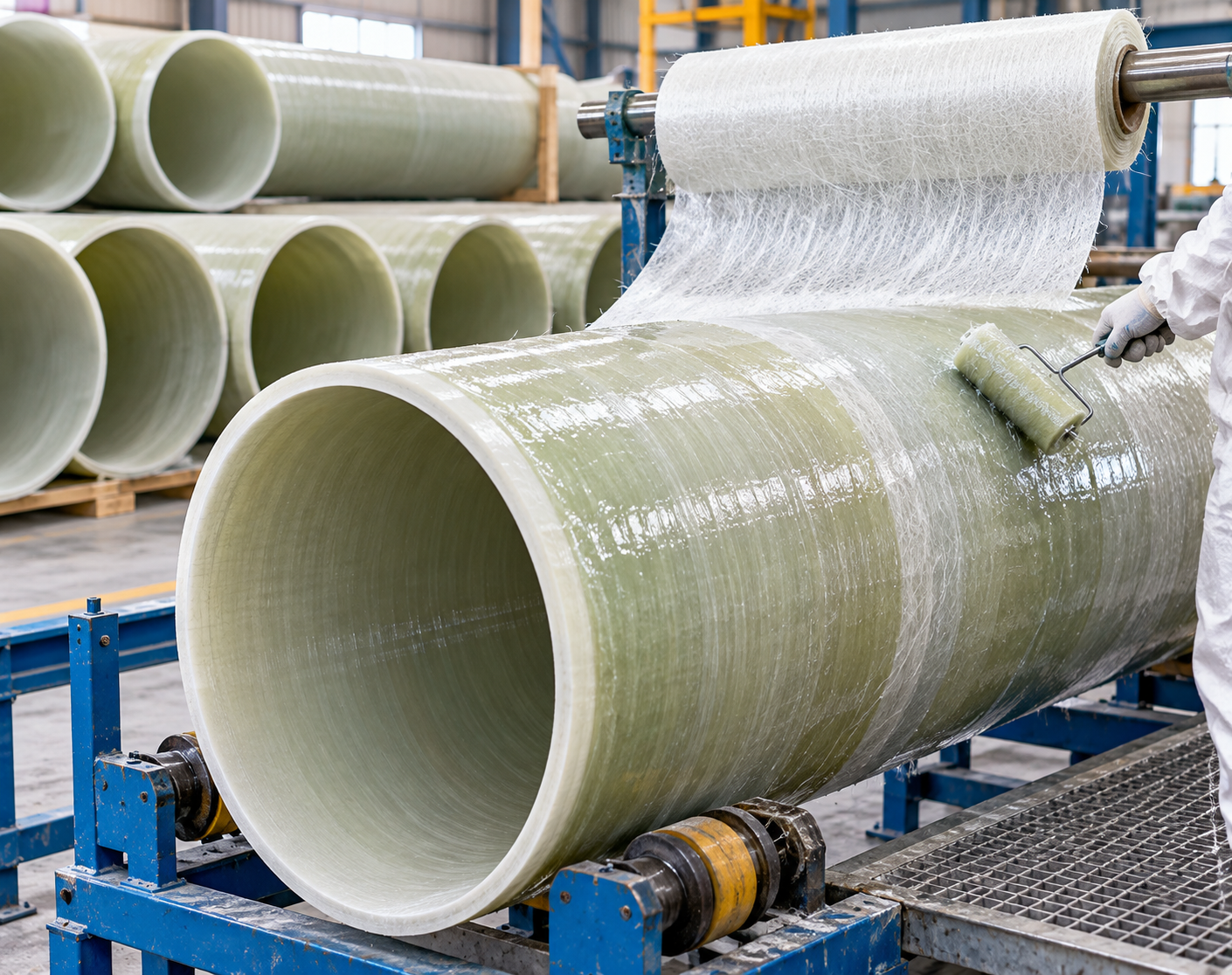
GRP (Glass Reinforced Plastic) pipe lamination is an engineered composite wrapping process used to strengthen, repair, seal, or protect critical pipelines by applying multi-axial layers of fiberglass reinforcement bonded with high-performance resin matrices. This methodology restores the hoop and axial structural integrity, eliminates leaks, and maximizes operating service life across demanding industrial networks.
Whether utilized for field butt-and-strap jointing during pipeline construction, restoring wall thickness lost to chemical erosion, or sealing localized pinholes and stress fractures under pressure, our specialized lamination systems create a seamless, non-corrosive structural repair without requiring line replacement.
Every lamination repair or jointing schedule is engineered to withstand specific internal operating pressures, thermal fluctuations, and chemical aggression:
| Component Material | Engineering Specification & Functional Purpose |
|---|---|
| Fiberglass Reinforcement | Alternating layers of Chopped Strand Mat (CSM 450/600 g/m²) for inter-laminar shear bonding and Woven Roving (WR 600/800 g/m²) for multi-directional tensile load support. |
| Thermosetting Resins | High-performance Vinyl Ester (for harsh acids, chlorine, caustics, and elevated temperatures) or Bisphenol / Epoxy resins tailored to match the parent pipe matrix. |
| Catalysts & Promoters | Precisely calibrated MEKP / Cobalt accelerators and promoters formulated for ambient curing conditions in Middle Eastern climate extremes. |
| Protective Outer Topcoat | Paraffinated UV-stabilized resin topcoat (flow-coat) providing a smooth, weather-resistant barrier against sunlight oxidation and external soil moisture. |
Our application follows rigorous composite fabrication standards (BS 4994 / ISO 14692) to guarantee complete mechanical bonding to the host substrate:
The pipe substrate is thoroughly cleaned, degreased, and mechanically abraded/roughened using grit disc grinding to achieve a clean, high-anchor profile.
An unreinforced, highly catalyzed resin primer coat is applied over the prepared profile to deeply penetrate micro-crevices and optimize chemical adhesion.
Pre-cut fiberglass mats (CSM and WR) are applied layer by layer with thorough resin impregnation, rolling with grooved de-aerating rollers to eliminate air entrapment.
The laminate is built up to the calculated design thickness, sealed with a UV-stabilized paraffin topcoat, and fully cured before non-destructive hardness testing.
Yes. In addition to GRP and GRE composite lines, our specialized composite wrapping systems bond effectively to carbon steel, ductile iron, concrete, and PVC pipes, restoring burst strength and providing long-term external corrosion protection.
Butt-and-strap jointing is a structural connection method used during initial pipe installation where two plain pipe ends are aligned and laminated together to create a monolithic continuous pipeline. Repair wrapping is applied over existing damaged, pitted, or leaking wall sections to reinstate structural design thickness.
Following application and chemical curing, our quality inspectors verify cross-linking using calibrated Barcol Hardness testers (ASTM D2583) and conduct ultrasonic thickness checks to ensure compliance with the specified design pressure class before line repressurization.
Yes. The cured composite repair laminate is completely non-porous and impervious to saline groundwater, acidic soil conditions, and microbial attack, making it suitable for direct underground backfilling without ongoing maintenance.